
Effect of S-glass Fibre and Nanoclay on the Tensile Properties of Epoxy Composites: A Comparative Study
Keywords:
Composite , S-Glass Fibre , Nanoclay , Epoxy , Mechanical PropertiesAbstract
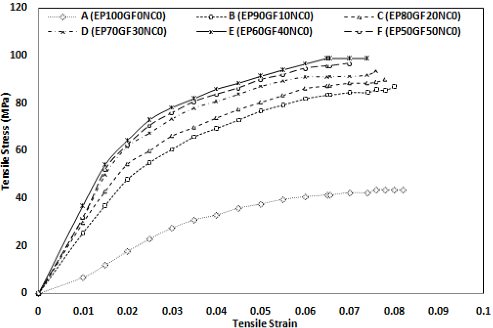
In this research work, the effect of S-glass fibre and nanoclay loading on the tensile properties of epoxy material are comparatively studied. Two groups of composites were fabricated, glass fibre/epoxy composites A, B, C, D, E, and F, which contains 0, 10, 20, 30, 40 and 50 wt.% S-glass fibre reinforcements respectively and nanoclay/epoxy composites A, B, C, D, E, and F with 0, 1, 2, 3, 4, and 5 wt.% nanoclay content, respectively. Tensile property of the all the composites fabricated were analysed and findings reported. Glass fibre/epoxy composite E, which contains 60 wt.% epoxy, 40 wt.% glass fibre was found to be the overall best performing composite. It possesses the following qualities: 98.93 MPa tensile strength, 1336.90 MPa tensile modulus and 0.072 strain at break whereas the best result on the tensile properties for nanoclay/epoxy group composites was obtained from composite E, which contains 4 wt.% nanoclay and 96 wt.% epoxy. It has the following behaviour; 60.837 MPa tensile strength, 845.00 MPa tensile modulus and 0.072 strain at break. The composite fabricated are suitable for wide range of applications such as aerospace industry for aircraft panel and body parts, marine for ship and vessels body parts, automobile industry for car bumper and body parts and civil engineering or structural engineering for high rise building frames etc.
Published
How to Cite
Issue
Section
Copyright (c) 2025 Lafia Journal of Scientific and Industrial Research

This work is licensed under a Creative Commons Attribution-NonCommercial-ShareAlike 4.0 International License.
How to Cite
Most read articles by the same author(s)
- Bisike Chidiebere Egere, Lawal Omeiza Yusuf, Philip Abubakar, Sunday Adaogoshi Eya, Catherine Okaigbo Oseshi, Effect of Hybridization on the Tensile Properties of S-glass Fibre/Nanoclay/Epoxy Composites , Lafia Journal of Scientific and Industrial Research: Volume 3, Issue 2 (October, 2025), Lafia Journal of Scientific and Industrial Research (LJSIR)
Similar Articles
- Okponmwense Moses, Omoye Shelah Omonzejie, Lawrence Ojong Ndip, Effect of Magnesium Oxide-Carbonized Hibiscus Sabdariffa (Zobo) Waste and Magnesium–Zinc Binary Oxide Nanocomposites in Mitigating Cadmium and Bacteria in Contaminated Water. , Lafia Journal of Scientific and Industrial Research: Volume 3, Issue 1 (April, 2025), Lafia Journal of Scientific and Industrial Research (LJSIR)
You may also start an advanced similarity search for this article.