
Evaluation of Radionuclide Concentrations in Drinking Water level of Dennis Osadebay University, Asaba, Delta State
Keywords:
Radionuclide , borehole water , health , activity concentrationAbstract
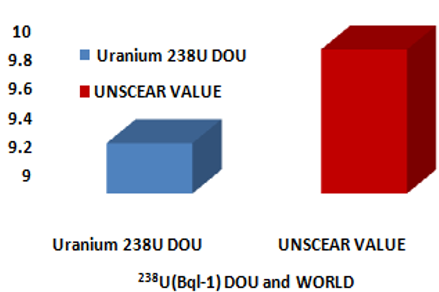
Potassium (40K), Uranium (238U) and Thorium (232Th) are radionuclides that are present in drinking water sources naturally or artificially. The exposure of humans and animals to these radionuclides in minute doses may cause chronic health issues in the future. This work analyzed the level of activity concentrations of Potassium 40K, 238U and 232Th in borehole water used for drinking and other domestic activities. Twenty-nine (29) samples were collected in a one-litre cylindrical air-tight polyvinylchloride container, thoroughly washed and sterilised. The samples were analyzed using a well-calibrated thallium-activated 3x3 Sodium Iodide NaI(Tl) detector at the Institute of Radiation Protection and Research (NIRPR). The results of the analyses showed that the activity concentrations of 40K, 238U and 232Th have mean values of 110.39 ± 19.21, 9.35 ± 2.01, and 5.21 ± 2.56, respectively, which were all above the world average recommended values of WHO and UNSCEAR. Therefore, the use of the water for drinking is toxic and detrimental to the physiology and the overall health status of the consumers.
Published
How to Cite
Issue
Section
Copyright (c) 2025 Victor E. Agbeyi, Oghenevovwero E. Esi, Johnson O. Etaghene (Author)

This work is licensed under a Creative Commons Attribution-ShareAlike 4.0 International License.
How to Cite
Similar Articles
- Abubakar Musa, Taiwo Adewumi, Sani Muhammad, Oladiran Johnson Abimbola, Low-Cost Weather Station Assessment of Urban Heat Island Compared with ERA5 Reanalysis Data , Lafia Journal of Scientific and Industrial Research: Volume 3, Issue 2 (October, 2025), Lafia Journal of Scientific and Industrial Research (LJSIR)
You may also start an advanced similarity search for this article.